
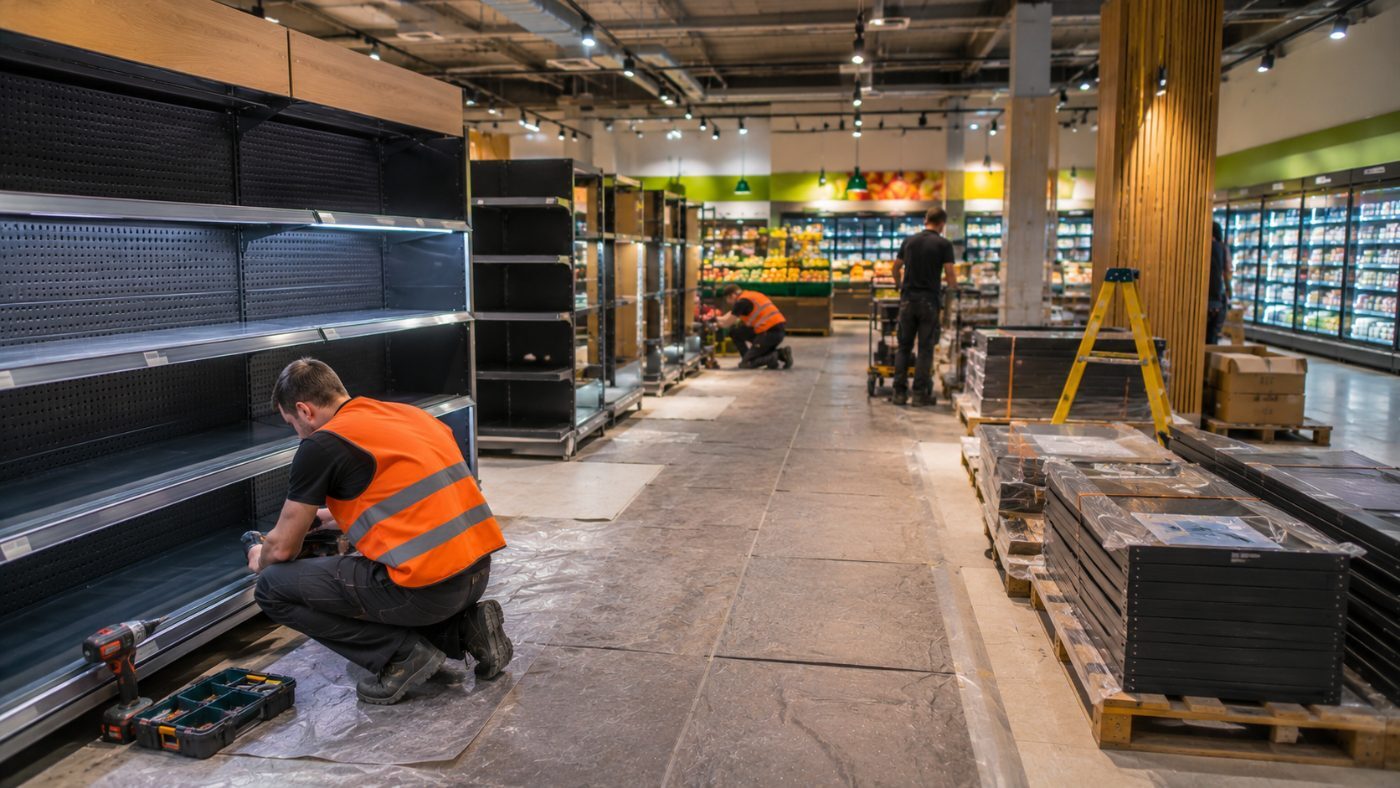
The short answer: A multi-site roll-out is not won by the number of installers. It is won by how well you plan for the things that will go wrong. Material arrives late, a survey is off, a vehicle breaks down — across 50 sites this is not a risk, it is a certainty. A good installation partner builds it in from the start: buffer in the schedule, decision rules agreed before the first night shift, and experienced installers who solve problems on site instead of calling headquarters at 2 a.m. This is the story of one such roll-out: a discount retailer, around 50 stores, rebuilt over two years, every one of them at night while the store stayed open by day.
The project: 50 stores, two years, night shifts
For a discount retailer we converted around 50 stores in Austria to a new store concept, spread over roughly two years in the Vienna and Salzburg regions. The scope was pure installation: every new fixture, fascia and built-in element was installed by us. Painting and other trades were not part of the contract — Emig delivered the store fixture installation.
The work happened at night, in stores that opened as normal every morning. One store took about a week with 12 installers, spread over four to five nights. That gave us one to two complete stores per week; at peak, up to 25 installers were on site in parallel.
The project in numbers
- around 50 stores, converted over roughly two years
- Vienna and Salzburg regions
- one store ≈ one week with 12 installers (4–5 nights)
- one to two complete stores per week
- up to 25 installers working in parallel at peak
- typical sales area per store: 800–1,200 m²
- essentially all stores completed on schedule
Who plans, who executes
On this roll-out the schedule came from the client: they specified which team had to be in which store on which night, and they placed their own site manager in every store. That made coordination on site easy. More often we build the roll-out plan together with the client — here the roles were reversed, and that works just as well as long as responsibilities are clear from day one.
The teams were a mix of our own installers and installation partners from our network. In every team, one or two of our own people led the shift. Their job: keep the sequence right, and find a solution quickly when something breaks. With 25 people and many parties involved, something always happens — somebody falls ill, somebody is late. On a project of this size nothing ever runs at 100 %. Having enough installers is one thing. Organising the deployment properly is the other, and it is the part that decides the outcome.
For an international client this is worth spelling out: you do not need to understand how German installers, subcontractors and night-work rules fit together. That is our side. Your side is a clear plan, a decision-maker we can reach, and material that arrives when it should.
The real lever: buffer instead of optimism
Roll-outs rarely fail for lack of manpower. They fail because the plan was too optimistic. Our rule is simple:
Never plan to the edge. Assume everything will take about 20 % longer than you believe today — and plan with that number. If it goes better, you have gained. If it does not, you are glad it was in the plan.
This buffer costs a little efficiency. In return the project runs calmly, the installers work with less pressure, and the result at handover is right. Over a 50-store series, that is the difference between a schedule that works on paper and one that still holds in the twentieth night.
The real checklist is a set of decision rules
Everyone has a checklist to tick off. What counts in practice are the decision rules agreed in advance — for the moment when something does not go to plan. Two examples: What do we do when material is missing? Do we carry on with what is there, or do we stop — and has that been agreed beforehand? What do we do when an area is not ready? Continue elsewhere or interrupt?
If those questions are answered up front, the installer does not have to improvise at two in the morning. Around that sit the practical things: experienced installers who see the shift through, logistics that fit, and a handover procedure that is simple enough for the crew — which photos are needed in which situation, kept clearly apart. And then the human logistics: accommodation, travel, rotation within the team.
When a vehicle breaks down on the way
One example of what this looks like in practice. The drive to the stores was long. On one of those drives a vehicle broke down — and the store still had to be finished that night. The installers already on site worked about two hours longer; the rest arrived later in a rental van. The result was right in the morning. Situations like this are part of every roll-out. What matters is that they do not derail the sequence.
On this project the material was delivered by the client directly to the stores, so inbound logistics were not ours to control. Accommodation was: because the journeys were long, teams usually stayed on site for two weeks at a time, in hotels and crew apartments. That, too, is part of the service — a two-year cadence only holds if the people behind it are housed properly.
Why it works commercially
A two-year roll-out means predictable utilisation — for us and for the installation partners in our network. External teams commit fully when you offer them a long-term, well-paid engagement with clear terms and a team that functions. Good installers exist in numbers. Putting them into the right conditions so that they actually succeed is the part we do well. It is less a question of any single installation than of a plan that thinks the project through from first to last store.
In more than twenty years we have seen a lot, including a lot that did not work. From that we know where the pressure points of a roll-out are. It does not mean everything always goes smoothly. It means that with the right installers, the right planning and clear guidelines, we get a clean result out of every situation.
FAQ: retail roll-outs in Germany with an installation partner
Can an international brand or fit-out company hand over the installation part of a German roll-out? Yes — that is exactly what we do. You keep design, sourcing and the overall programme; we deliver the store fixture installation across all sites with our own installers and network partners, managed in English.
How many stores per week are realistic? It depends on store size and scope. On the roll-out above, one store of 800–1,200 m² took a 12-installer team four to five nights; that gave one to two complete stores per week per team. Parallel teams scale that up.
Can the work be done at night while the store stays open? Yes. Night work in open stores is standard for us; the example above ran entirely on night shifts over two years.
Who provides the roll-out schedule? Either you or we do — both work. What must be clear is who decides on site when something deviates from the plan.
Which regions do you cover? Germany nationwide, plus Austria, Switzerland, France and the Benelux countries.
Manuel Emig, Emig Ladenbau GmbH — retail installation partner, Wald-Michelbach, Germany. Own installers plus a coordinated partner network, on site in Germany and across Europe since 2004. Based on our project practice; last reviewed September 2026.