
What is a roll-out installation? Types, process, teams, logistics
What a roll-out means in store installation, which three types exist and how a roll-out across 20, 50 or several hundred locations actually runs. Lessons from more than 100 roll-outs in Germany and across Europe, written for project managers at retail chains, manufacturers and shopfitters.
What is a roll-out installation?
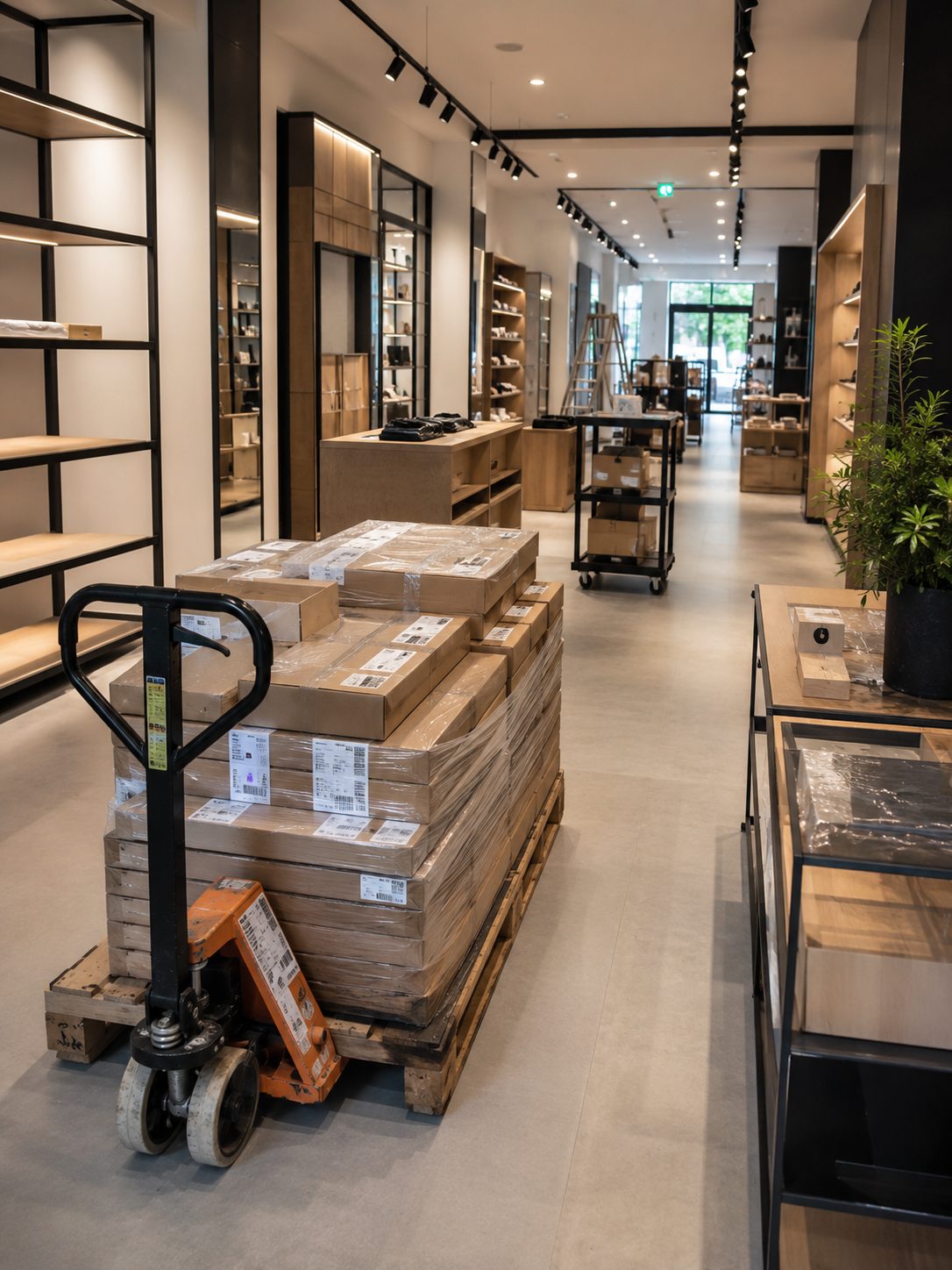
A roll-out installation is the installation of the same or a similar store fit-out at many locations, in a fixed sequence and usually on a weekly cycle. The craft is the same as for a single store. The difference is volume: what costs half an hour at one location costs several days across 50 locations. That is why a roll-out is won or lost in the planning, before the first day on site.
This page sums up what we have learned from more than 100 roll-outs. That ranges from a two-person team replacing one module in many stores to a complete refit with many teams at the same time. It is written for project managers who are planning, tendering or awarding a roll-out.
Not every roll-out is the same roll-out
Building a store concept 25 times over, swapping one shelving unit in 100 stores or completely refitting 50 supermarkets: all of it is called a “roll-out”, but they are different jobs. Team size, duration and cycle differ, and so do the clients. So when you ask about a roll-out, start by saying which type it is.
New build at many locations
The same store concept is built from scratch at new locations, one opening after another.
Typical: 2 to 12 fitters per location, days to weeks per location.
What matters to the client: the opening date holds, and every location looks the same.
Module roll-out
A single element is installed or replaced in many existing stores, for example a shelving unit, a display case or a checkout zone.
Typical: two-person teams, a few hours to one day per store, often several stores per day.
What matters to the client: many stores per week and photos of every store.
Complete refit
Existing stores get completely new fixtures. We remove the old ones and install the new ones. In supermarkets this happens in sections or, when needed, at night, because the store stays open.
Example, discount retailer roll-out: 12 fitters per store, 4 to 5 nights, 1 to 2 stores per week.
What matters to the client: the store opens on time in the morning, and a back-up team is lined up.
How a roll-out runs: from the location list to the last handover
It starts with the list of locations: which stores, in what order and with what scope. That becomes the roll-out plan, which sets out which team is where and when, and when deliveries and handovers happen. Then we assign the teams and book travel and accommodation.
Every location follows the same routine. The day before, the client confirms that everything is ready. The team installs to plan and reports to the project manager. The job ends with a handover report and photos, and any open items get a date. The routine is deliberate: a team that has done it in ten stores needs no briefing in the eleventh. That is why roll-outs speed up as they go.
Behind the scenes, one project manager keeps track of every location. They move teams when a store isn't ready and deal with the client on any changes. At Emig, it's the same person from the first store to the last.
The roll-out plan, and why we add 20 %
It doesn't much matter whether the client writes the roll-out plan or we write it together. On a discount retailer's roll-out in Austria, the client set the plan and put its own site manager in every store. More often, we draw up the plan with the client. Either way works, as long as the order of locations, the delivery window for each store and who decides what on site are agreed.
Roll-outs rarely fail for lack of fitters. More often, the schedule was too tight from the start. So we plan with around 20 % extra time. It costs a little efficiency, but one bad day no longer knocks the whole weekly schedule over. If things go better than planned, that's time in hand.
How many stores you can do in a week depends on the type. On a complete refit, a store with 800 to 1,200 m² of sales floor took 12 fitters four to five nights, so one or two stores a week. On a module roll-out, a two-person team can often do several stores a day. We agree the figure before the start.
Teams: our own fitters and partner teams
We work with up to 50 fitters and more when needed, our own and partner teams. The teams are made up of our own fitters and partner teams from our network, and each one is led by one or two of our own people. They know the routine and make the call on site when something doesn't fit. At two in the morning, in front of a missing shelf, you need someone who is allowed to decide.
A roll-out that runs for months means steady work for our fitters and our partners. A team that has worked together for a while performs differently from one put together at short notice. Part of that is getting accommodation, travel and crew changes right.
People will be off sick. With that many people on a job, someone always is. The weekly schedule still holds, because the buffer is in the plan and we line up cover before we need it.
Logistics and material: who delivers, who installs
For large roll-outs, we recommend giving the logistics to a separate company that delivers the material just in time, straight to the stores. We agree the dates with them, so the goods are there when the team arrives, and we take over from delivery. Smaller quantities we can store at our own warehouse.
On a roll-out across more than 200 petrol stations, matching the teams to the deliveries was what mattered most. Every station was reported back the same day. Packaging and leftover material always need to be in the plan, or by the third location there's a lorry full of cardboard in the way.
Where travel distances are long, teams stay on site for several weeks at a time, and we organise hotels and crew accommodation. Roll-outs abroad also come with that country's registration rules, such as the SIPSI declaration in France.
The day-before check: a list the client confirms
Before each location, we go through a fixed list with the client, and the client confirms each point to us, not the store. Measurements and drawings must match the space, and all the material must be on site, small parts included. Access, keys and alarm must be sorted, with a name and a number we can reach at night. There must be power, light and somewhere to put the waste. The store manager knows we're coming, and the areas are cleared.
The list is kept short on purpose. It doesn't replace site management. It prevents the routine mistakes that cost the most across many locations: an open point costs half an hour at one store, and days across 50.
When something goes wrong: rules before the first day on site
On every roll-out, something will be missing somewhere, a measurement will be wrong or a site won't be ready. So we plan for unfinished locations from the start. What matters is agreeing the rules in advance. Before the first day on site, we settle four questions with the client: do we carry on with what's there, or move the location? Who decides that on site? Is a return visit agreed? And how is it documented and invoiced?
With those answers in place, nobody has to improvise. For what can be settled beforehand and what has to be decided on site, see our article When the site is not ready.
Handover and documentation: every store, the same day
Every store is handed over with a report and photos taken to an agreed template, and any open items get a date for follow-up. The simpler the photo template, the more complete the documentation. On module roll-outs the photos often matter most, because the manufacturer uses them to invoice its own customer.
Invoicing goes through the project manager, broken down by location. The same applies to partner teams on a roll-out; for what a subcontractor's invoice needs to include, see our article Invoicing as an installation subcontractor.
What drives the effort of a roll-out
We only quote once we have the location list, the timeframe and the scope, but the cost drivers are the same on every roll-out. The type matters most: a complete refit at night costs many times more per store than a module roll-out during the day. Next comes the scope per location, and how alike the locations really are. Distances and overnight stays play a part, as do working hours, access and deliveries. Finally, it depends on how detailed the client needs the documentation to be.
A roll-out costs less when the location list stays stable and the client takes the day-before check seriously. It costs more when the plan has no buffer.
Who commissions a roll-out and what they expect
In practice there are three kinds of client. Retail chains and general contractors award complete refits and expect the store to reopen on time. Manufacturers and suppliers award module roll-outs; they need many stores a week, and photos they can invoice their own customer with. Shopfitters award new builds at many locations. For them, the opening date has to hold and every store has to look the same, in Germany and abroad.
Emig Ladenbau handles all three, with our own fitters and partner teams, in Germany and across Europe. We don't supply the fixtures, and we only take on electrical, painting and flooring work on a small scale. Our job is installation, documentation and handover. For a first assessment, the location list, timeframe and scope are all we need.
Frequently asked questions about roll-out installation
What is the difference between a roll-out and a store refit?
How long does a roll-out across 50 stores take?
Can a roll-out take place while the store is trading?
Who draws up the roll-out plan?
Which documents does an installation partner need for a roll-out?
Does Emig carry out roll-outs outside Germany?
All articles on roll-out installation
- Planning a roll-out installation: what belongs in the roll-out planMeasurements, delivery, cycle, time buffer and rules for locations that are not ready.
- Store roll-out in practice: 50 stores in two yearsA discount retailer's roll-out in Austria, at night with the store open, with 12 fitters per store.
- Shelving installation across 200+ petrol stations: why logistics comes firstInstallation on a weekly cycle, matched to the deliveries.
- When the site is not readyWhat gets settled beforehand and what is decided on the spot.
- Shop-in-shop installation: process, coordination, handoverInstallation in a department store that stays open, step by step.
- What makes a store installation workWhat good installations in Germany depend on, and where they fail.
- Installation in France: what manufacturers should know beforehandLanguage, procedures, registrations, experience from our projects.
- A1 certificate for installation work in the EUWhat clients and installation teams need to settle before the job.
- Which documents clients expect from subcontractorsExemption certificate, A1 and insurance: the list we need before every job.
- Invoicing as an installation subcontractor: mandatory details and § 13bA checklist so the invoice is accepted first time.