
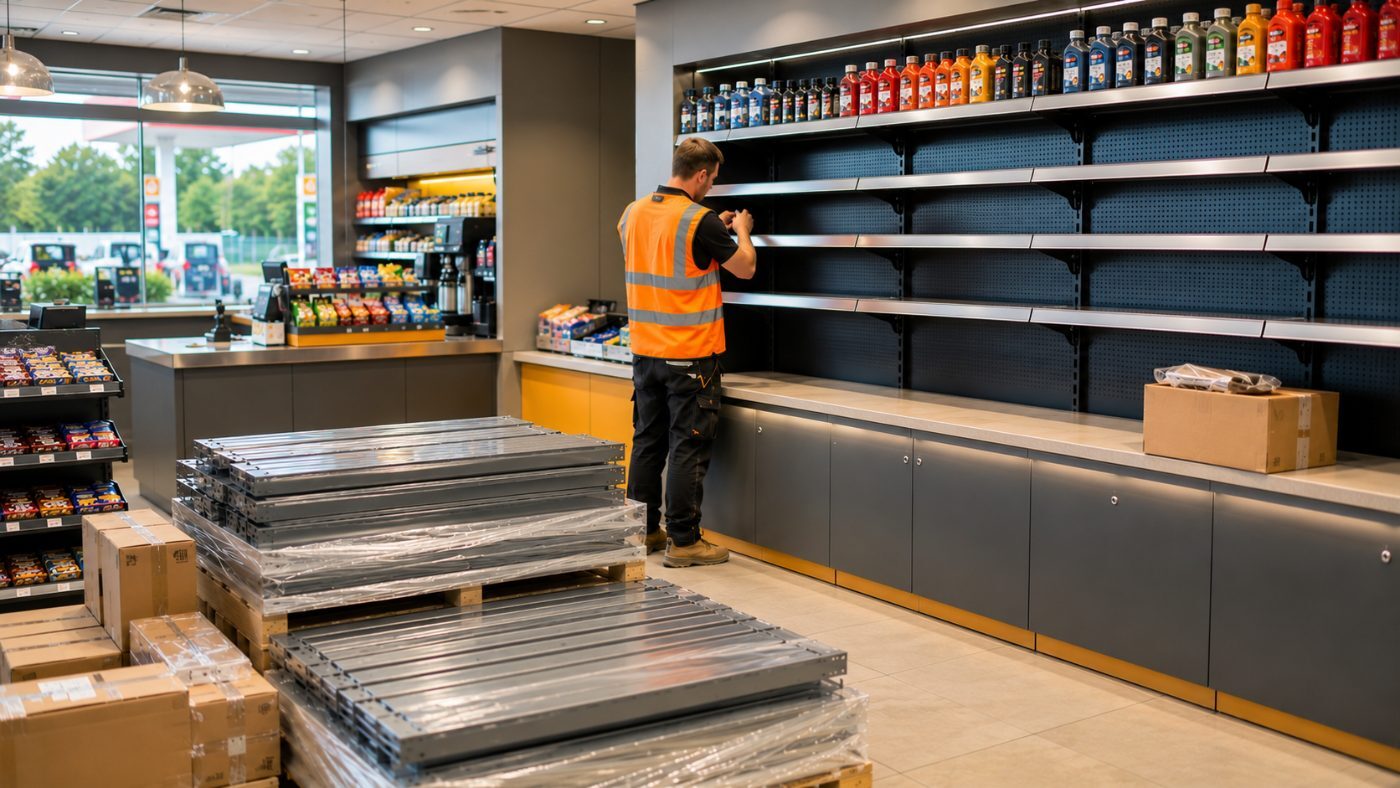
In a serial installation across many fuel stations, it is not the installation itself that decides the outcome, but the logistics before it. Anyone planning shelving installation in a fuel station easily underestimates how much happens before the actual assembly: all individual parts have to be picked per station, loaded, delivered and only then installed — during ongoing operation, under fire safety requirements and with a sign-off on site. This is where the real effort lies. In a project running over several years, Emig installed the cigarette shelving in around 100 to 150 stations, 5 to 10 stations per week. This article shows what matters.
What it is about: shelving installation, not a building site
A fuel station is not a shop that you close for a refit. Sales continue, customers keep coming, and the installation takes place in the middle of it all. The project described here was not a complete refit but a clearly defined task: re-installing the cigarette shelving behind the checkout area — serially, across around 100 to 150 stations and over several years, with a throughput of 5 to 10 stations per week.
That sounds manageable. The effort lies elsewhere.
The real effort: picking
All individual parts for the shelving were delivered centrally to Emig — not pre-sorted for the individual stations. That means: for each branch, the right parts had to be assembled, loaded, delivered and then installed. This picking (Kommissionierung) was the real effort of the project, not the assembly itself.
At 5 to 10 stations per week, this becomes a permanent logistics task: for every station, the right material has to be in the right place at the right time. A mistake in picking does not cost an hour, it costs an entire trip.
The project in figures
- around 100 to 150 stations
- over several years
- 5 to 10 stations per week
- per station: pick, load, deliver, install
- installation during ongoing operation
- sign-off with the site operator on site
What is different at fuel stations
Beyond the logistics, a fuel station demands things that do not exist in ordinary shopfitting:
- Fire safety and security. Stricter safety precautions apply. Every fitter needs a mandatory briefing beforehand, plus special safety clothing. Without this, nobody gets onto the premises.
- Ongoing operation. The station stays open. The refit takes second place to sales, not the other way round.
- Handling of goods. The cigarettes have to be cleared out and restocked — a topic in its own right that needs to be organised so that nothing goes missing and the area is ready for sale again quickly.
- Sign-off with the site operator. Acceptance is not only given centrally, but with the site operator or owner on site. That means the result also has to convince the person who runs the station every day.
Where things go wrong — and how to deal with it
To be honest, even with a well-rehearsed process, not every station runs smoothly. The most frequent cause in this project: the site measurements were wrong — they came from the client, not from us. The result was repeated trips because parts did not fit or were missing. Occasionally a site operator was unhappy with the interim state, even though the cause lay on the client side.
For us, this is not an exception but part of the job. Anyone running a series across a hundred or more stations plans for such trips instead of being surprised by them. The aim is for the process to remain stable and for the station to be handed over cleanly in the end — regardless of where a mistake came from.
What a client can take away from this
In a serial installation in the convenience sector, an installation partner should be judged less on how quickly it assembles a shelf than on how well it masters the logistics beforehand. Efficiency here comes from picking and planning, not from the spanner. It simply has to work well — week after week, over years, without sales at the station suffering as a result.
Planning a series in the convenience or fuel station sector? Tell us the number of stations, the timeframe and the scope — we will check dates, logistics and capacity.
Tell us about your project