
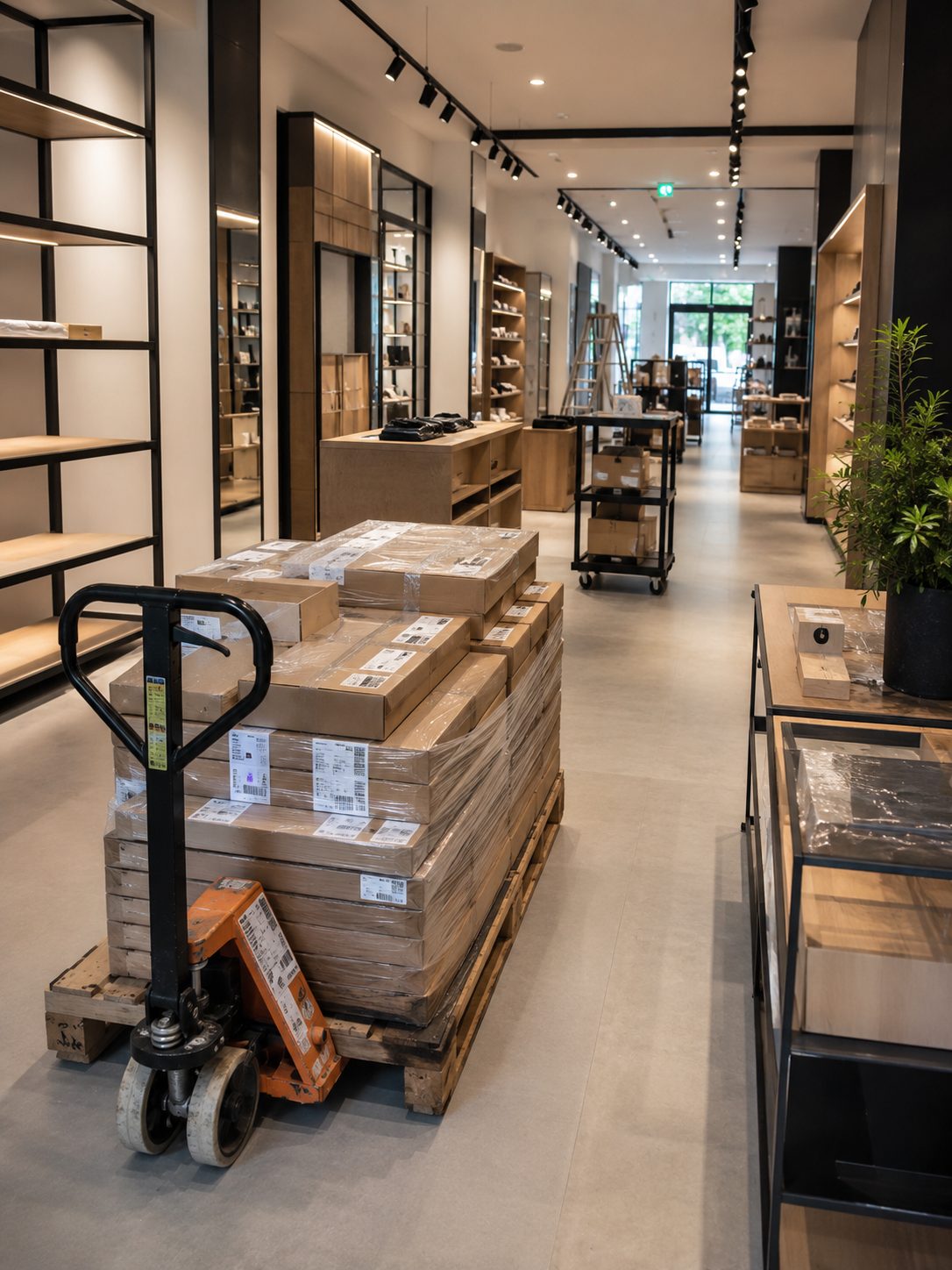
Planning a roll-out installation means one thing above all: do not cut it fine. Anyone having store fixtures installed in series across many locations plans not for the ideal case but for the normal case — and in the normal case, material arrives late, a site survey is wrong or a team drops out at short notice. A robust roll-out plan allows for that: with around 20 % time buffer, with decision rules for failures agreed in advance and with experienced fitters on site. That keeps the process stable even in the fiftieth store. This article shows what that looks like in practice.
What "planning a roll-out installation" actually means
Planning a roll-out installation is different from fitting out a single store. It is about a series: the same or a similar fit-out, at many locations, in a fixed weekly cycle, often during ongoing trading. The roll-out plan defines which team is at which location when, how the material flows and how sign-off is done. Three things have to come together: the process, the teams and the material flow — ideally from a single source.
How large such a series can become is shown by a discounter roll-out we carried out in Austria: around 50 stores, refurbished over about two years, each at night during ongoing trading. One store took about a week with 12 fitters over four to five nights, one to two complete stores ran per week, and at peak times up to 25 fitters were deployed in parallel. Essentially all stores were finished on schedule.
Reference figures from a real roll-out
- around 50 stores over about two years
- weekly cycle: one to two stores per week
- 12 fitters per store, 4–5 nights
- at peak times up to 25 fitters in parallel
- refurbishment at night, store open during the day
- essentially all locations on schedule
The roll-out plan: sequence, teams, sign-offs
The core of the planning is the sequence: which location first, which team goes there, when is delivery, when is sign-off. A fixed weekly cycle with clear responsibilities has proven itself — per team, one to two permanent people who lead the deployment and decide when problems arise. Whether the roll-out plan comes from the client or is drawn up by us together with the client is secondary, as long as the roles are clearly allocated and someone bears responsibility at every location.
What matters is what the plan covers beyond the ideal case. A roll-out plan that only describes the smooth process is not a plan but a hope.
The most common mistake: too much optimism
Roll-outs rarely fail for lack of manpower. They fail because time was calculated too tightly. Our principle:
Do not plan to the limit. Assume that you will need around 20 % longer everywhere than you believe today — and plan with that. If it goes better, that is a gain. If it does not, it is good that it was planned for.
This buffer costs some efficiency and brings stability in return. In a series across dozens of locations, that is the difference between a plan that collapses at the first incident and one that holds.
The typical sources of error — and how to plan for them
Most problems on a roll-out arise not during the installation itself but before it: missing material, a wrong site survey, a last-minute change of plan. That cannot be prevented, but it can be anticipated. The real "checklist" is therefore not a set of tick boxes but decision rules that are settled before the first deployment:
- Material missing: Do we carry on installing with what is there, or is the location postponed? And has a follow-up installation been agreed beforehand?
- Area not prepared: Carry on or stop — who decides that on site?
- Team drops out: How is this adjusted without losing the weekly cycle?
- Sign-off: Which photos are needed in which situation? The simpler the requirement, the cleaner the documentation.
If these questions are answered in advance, nobody has to improvise at night. Added to that are the practical things that make a deployment lasting several weeks work in the first place: accommodation, travel, changes within the team.
Why predictable workload safeguards quality
A roll-out over months or years means predictable workload — for our own fitters and for the installation partners in the network. A well-rehearsed team with clear terms pulls together differently from one assembled at short notice. This is exactly where a part of the planning lies that is rarely seen from outside: putting good fitters in conditions under which they can work successfully. In the end, that is the basis for a roll-out installation staying consistently clean across many locations.
Planning a series across several locations? Tell us the number of locations, the time frame and the scope — we check dates and capacity and draw up the roll-out plan with you.
Tell us about your projectIn brief
Planning a roll-out installation means planning for the normal case and not the ideal case: a fixed weekly cycle, clear responsibilities, around 20 % buffer and decision rules for the moment when something does not go to plan. Process, teams and material flow belong in one hand. Then the result at every location is clean in the end — even where there are hitches along the way.