
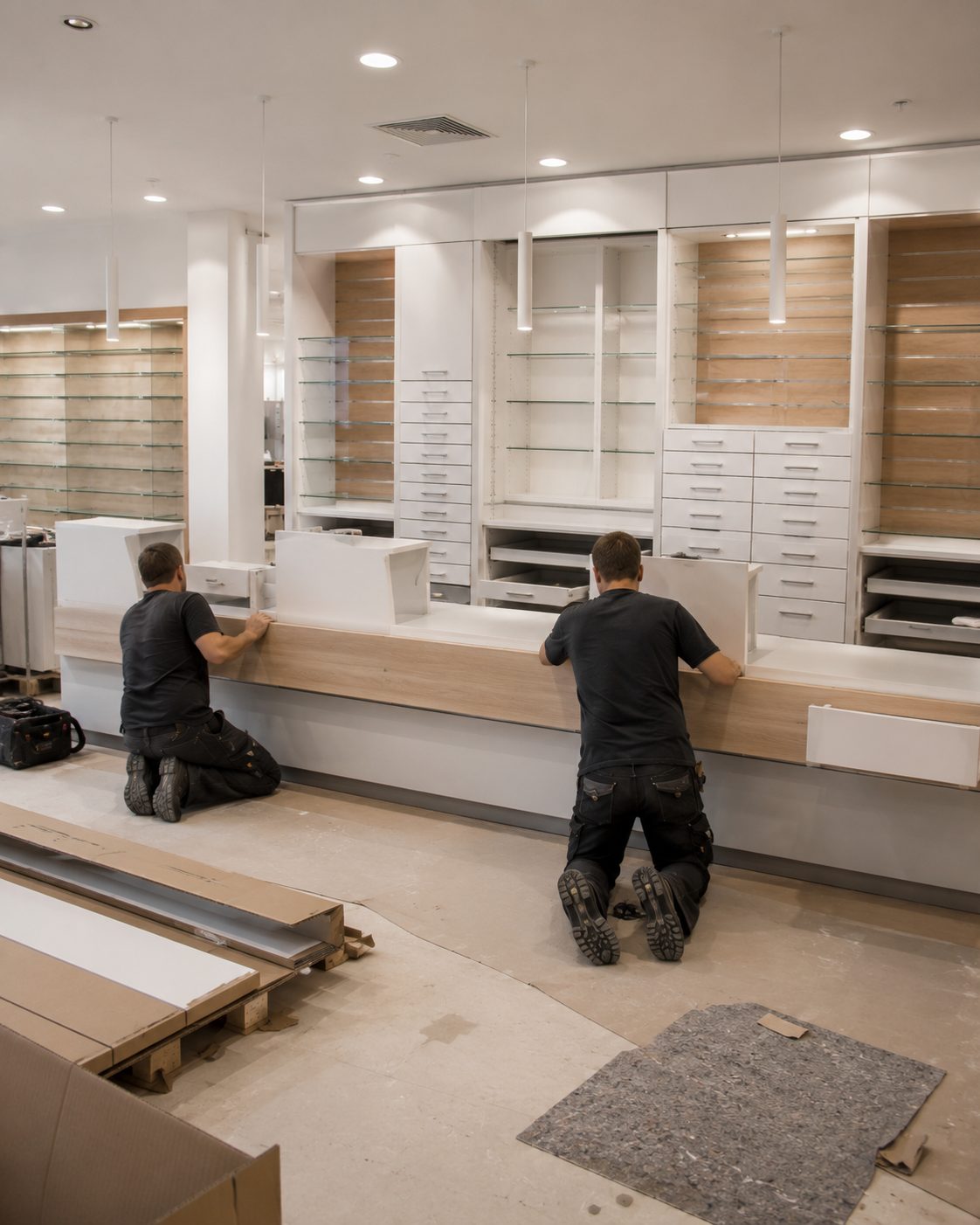
A shop-in-shop is a brand's own area inside someone else's store — in a department store, a supermarket, a specialist retailer, a fuel station. The refit usually takes place while the store is open, with customers on the shop floor: the store does not close because one area is being rebuilt. For the installation, this means that consideration for customer traffic, secured work areas and a tidy appearance are as much part of the job as the installation itself. Added to this are two points where things regularly go wrong in practice: the material is often delivered in advance and stored somewhere in the store, and there needs to be a reachable person on site who provides access and knows where the goods are.
What defines a shop-in-shop installation
A shop-in-shop is a defined area belonging to a brand inside someone else's store. The best-known examples are the brand areas in department stores. But the cosmetics shelving in the supermarket, the brand area in the specialist retailer and the section in the fuel station belong to the same category. The brand has an agreement with the operator of the space, and its fixtures stand on it.
For the installation, this leads to the one difference from which everything else follows: The store belongs to someone else. The client is the brand or its manufacturer. The premises are controlled by the store. Access, delivery times, working hours and the question of whether drilling is allowed at all are decided not by the client but by the store.
The second difference is size. A shop-in-shop area ranges from a single piece of furniture that is set up and aligned to an elaborate cosmetics wall with lighting, back panels and electrical connection. There is therefore no general statement about duration and team size — only one about the process.
The refit takes place while the store is open
The normal case is not the night. The normal case is Tuesday morning, with customers between the shelves. A store does not close because a brand area is being rebuilt. The areas next to it keep selling.
For the installation, this means four things.
The work area must be secured. Barriers, no trip hazards, no exposed cables, no tools in the way. A customer who falls in the area is a problem for the brand and for the store.
Noise and dust are limited. What cannot be avoided is moved to off-peak hours or screened off. Dust-intensive work next to an open fresh food counter is not possible.
Material is not transported across the sales floor, at least not during opening hours.
Appearance counts. The installation team works in front of the brand's end customers. Tidy, quiet, approachable. Whoever is in the way steps aside. This is not a soft point — it is the part of the job that the store manager rates in the end.
Work takes place at night or before the store opens when there is no other way: for larger dismantling, for noise, for work that blocks the area completely. That is the exception, and it must be agreed with the store — access, keys, alarm, someone to unlock.
Clarifying in advance how work may be carried out does not make anyone faster. It avoids trouble. A disrupted sales floor, an annoyed store manager and a brand that complains to the manufacturer cost more than the installation itself.
Where exactly is the material?
A shop-in-shop delivery is small. Not thirty pallets, but a few elements. That is exactly why it is rarely delivered on the installation day, but beforehand.
Two routes are common, and the difference belongs before the contract is awarded:
The material goes to the installation company in advance. We receive it, check it, load it and bring it along. Then it is clear on the installation day what is there — and anything missing was noticed beforehand.
The material goes directly to the store. The carrier delivers days in advance, the store accepts it and puts it down: in the stockroom, at the loading ramp, in the back yard, in the neighbouring department. That is the more frequent case.
And here is the point one should know: As a rule, nobody checks the delivery on arrival. The store has no interest in the box and no parts list. It accepts it and puts it away. Whether everything is there, whether something is damaged, whether an element is sitting on another pallet in another branch — the installation team finds that out when it arrives on the installation day and opens the boxes first thing.
Those who know this clarify in advance:
- Where does the delivery go — to the installation company or to the store?
- Who accepts it, and who signs for it?
- Where exactly is it stored, and who knows about it on the installation day?
- What happens if an element is missing or damaged? Who delivers the replacement, and within what time?
A missing element decides whether the area is finished in the evening or whether a second site visit becomes necessary. At a single location that is annoying. In a series across thirty stores it is a process problem.
Briefly describe your project — we check dates and capacity.
Tell us about your projectThe reachable person on site
There is no fixed title. Sometimes it is the store manager, sometimes the department head, sometimes the building technician, sometimes the centre management. Who is responsible differs from store to store.
What is always needed, however, is a telephone number that is known before the installation day. This person provides access, knows where the delivery is, knows the house rules and is reachable when something is not right.
Without this number, the installation day begins with a search — for the material, for the key, for someone who is allowed to decide something. That is the most frequent cause of lost hours in shop-in-shop installations, and it costs nothing if the question is asked beforehand.
Who clears the area
The goods in the area belong to the store or the brand, not to the installation. They are cleared by the store, not by the installation team. That is the rule, and it makes sense: stock, security and restocking are the retailer's responsibility.
Only the timing needs to be clarified. An area that is still full on the morning of the installation blocks the start — and the team waits for people who are currently serving customers.
Dismantling and disposal
The cost block that is missing from most quotations and appears on most invoices.
To be clarified: Who dismantles the old fixtures? Who carries them out — and by which route, if the customer area is off limits? And above all: Who disposes of them? Disposal often has to go through the store, with its containers and its rules. Sometimes it goes back to the manufacturer. Sometimes the installation company takes it on.
Three options, three different prices. Only one of them ends up in the contract.
Quality: the area stands next to other people's goods
A shop-in-shop area is not judged on its own. It is judged in direct comparison with what stands to the left and right of it.
That is why details count here that nobody sees in an empty new build: clean joins to someone else's floor and someone else's wall, straight alignment with the neighbouring area, even joints, working lighting. The area has to look as if it had always been there.
Then there is the second assessment, which hardly anyone says out loud: The store judges what the refit was like for it. Was it clean? Was it quiet? Was the area secured? Were the customers in the way, or the team? This assessment lands with the brand, and the brand passes it on to the manufacturer.
Sign-off: who signs, and against what
Acceptance usually has two sides.
The brand signs off against its concept. The basis is the concept manual or the planogram: Is everything in the intended place, in the intended version, does the lighting work?
The store releases the area. Clean, safe, ready for sale. No packaging material, no tool marks, no leftover waste behind the shelving.
What needs to be clarified beforehand is who on site is actually allowed to sign. The brand's area manager is often not in the building. Then a rule is needed: Who signs off instead, and what happens if nobody is there?
What remains in any case is the photo documentation. For a series across several stores, there is an additional requirement: the same structure, the same perspectives, the same format at all locations. Otherwise thirty areas cannot be compared later.
Series instead of a single area
A brand rarely refits one area. It refits thirty, or a hundred. That turns the shop-in-shop installation into a roll-out — with everything that comes with it.
In practice, this means: first a sample area, then the series. Whatever comes to light at the first location — a component that does not fit, instructions that show something different from reality, a tool that is missing — is incorporated before it repeats itself twenty-nine times.
And: from the third area onwards, the same team becomes noticeably faster. Whoever changes teams starts from scratch every time. How a series installation across many locations is planned is described on our page on roll-outs and store refits.
How Emig installs shop-in-shop areas
Emig Ladenbau has installed several hundred shop-in-shop areas, in series and during ongoing operation. In more than 20 years and more than 2,000 installation projects, these were areas in department stores, in supermarkets and at discounters, in specialist retailers, at fuel stations and in the luxury segment — in Germany and across Europe, for renowned international brands that we do not name here.
That is not a list of references, but the actual point: The number of constellations in shop-in-shop is limited, and we have had most of them before. The goods lift that the back panel does not fit through. The store that only unlocks between 22:00 and 6:00. The delivery that arrives two days late while the time window stays the same. The customs entry on the delivery note for an area abroad. A process that looks completely different between a discounter and a luxury area in the same country.
What a client buys from an installation company is not enthusiasm but the absence of surprises. That does not come from a good reference, but from having had the same situation before.
We work with our own fitters and a well-established network of partner companies. There is one fixed contact person for the entire project, and handling is in German, French and English. Standard on every job: a tidy appearance in front of the end customer, documented sign-off, punctual handover.
More on this on the page shop-in-shop systems. See references.
FAQ
How long does a shop-in-shop installation take?
Does the installation have to take place at night?
Where is the material delivered to?
Who clears the goods from the area?
Briefly describe your project — we check dates and capacity.
Tell us about your project